Homer
ACTIVEbetaParametric components for home design — a dual-engine 3D studio in the browser.
- Ref
- WRK-9B803C
- Section
- SEC-02 // WORKS
- Status
- ACTIVE
- Stage
- BETA
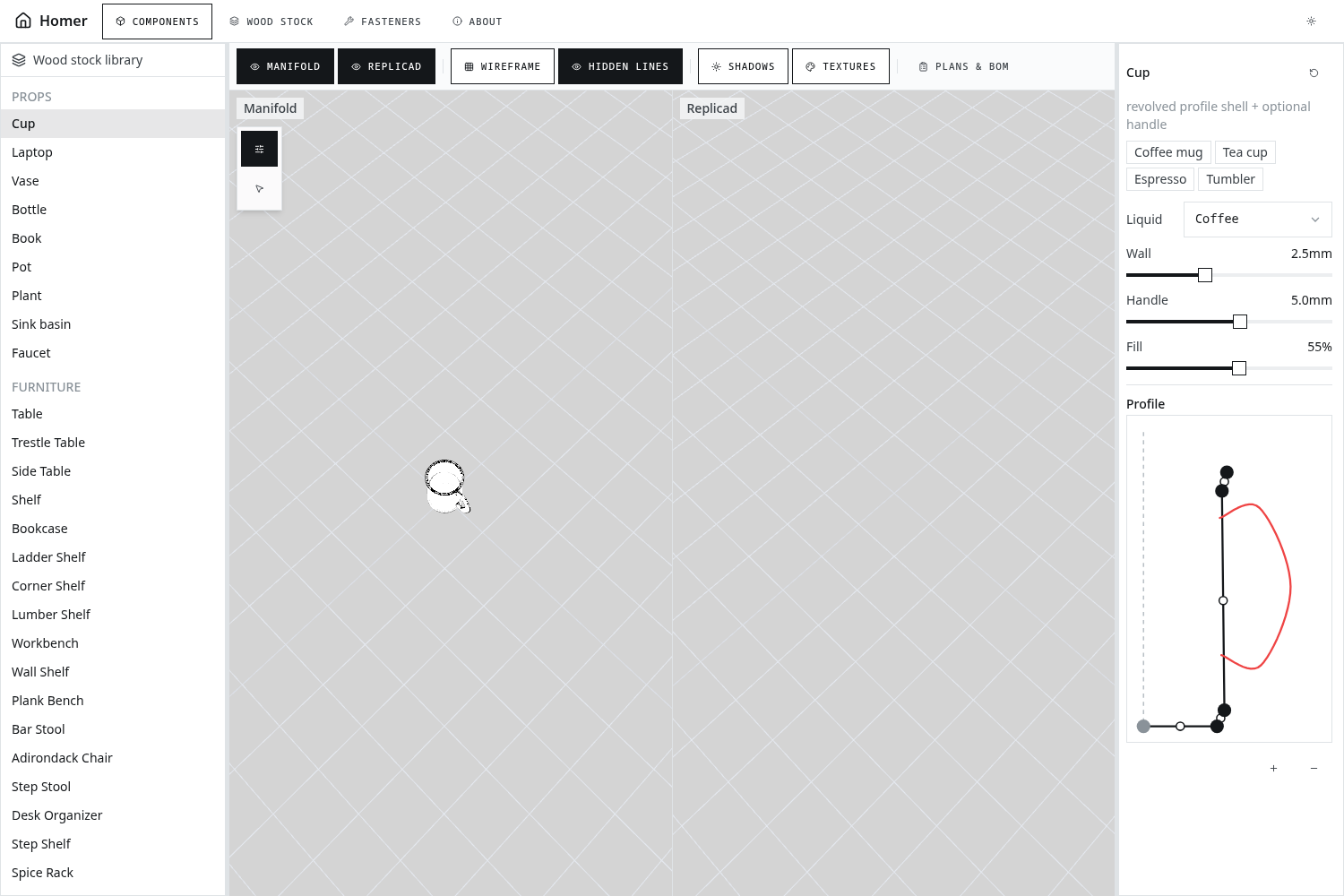
Homer is a browser-based parametric 3D component studio for home design. Every component — cups, gears, planters, bookcases, closets, kitchen cabinet runs, desks, lumber shelving, sinks, whole rooms — is built side by side by two independent geometry engines: manifold (main-thread WASM CSG) and replicad/OCCT (a worker-thread CAD kernel), rendered in synced three.js viewports.
Why
Parametric CAD in the browser usually means committing to one geometry kernel and living with its blind spots. Homer runs two: a fast CSG engine for instant feedback and a full OpenCASCADE kernel for CAD-grade solids. Building every component twice, from one shared parameter model, keeps both engines honest — a divergence between the viewports is a bug surfaced for free.
How it works
- Dual engines, one param panel. A shared params panel drives both builds; drag handles snap to standard dimensions. Cameras stay synced across viewports.
- Engine-agnostic geometry core.
shared/cad/*holds the geometry models (cabinet, closet, desk, sink, lumber catalog, …) consumed by both engines — the component definition is data, the engines are interchangeable backends. - OCCT off-thread. The OpenCASCADE WASM kernel loads dynamically inside a web worker, keeping the main thread responsive while CAD builds run.
- Wood stock library.
/stockcatalogs purchasable lumber, plywood, engineered board, and MDF at real-world dimensions with $/sq-ft pricing and a real-scale 3D preview. - No server. Nuxt 4 SPA, no API routes, no database — configs persist to
localStorage.
Status
Live in production at homer.exesiv.dev.
Links
- Live app: homer.exesiv.dev